
OPRA vs Court Records in Somerset County
Two separate legal frameworks govern public access to records in Somerset County, and they do not overlap. County executive records fall under the Open Public Records Act, N.J.S.A. 47:1A-1 et seq. OPRA covers the Board of County Commissioners, the Sheriff's Office, the County Clerk, the Surrogate, county departments, and other county agencies. These are the records you request from the county OPRA custodian using a JustFOIA form or PDF request.
Court records follow a different path. The Government Records Council has stated that the Judicial branch is not a public agency under OPRA. That includes the Supreme Court of New Jersey, the Superior Court, municipal courts, the Administrative Office of the Courts, and related Judiciary offices. So a request for a Superior Court case file, a divorce record, or a criminal judgment does not go through the county OPRA custodian. It goes through the NJ Judiciary, governed by Court Rule 1:38 and Judiciary procedures. You would use NJ Courts Find a Case for online access or Judiciary Records Request Form CN 10200 for paper copies.
The distinction matters in practice. Someone looking for a deed filed with the County Clerk files an OPRA request or searches the Acclaim land records portal. Someone looking for a civil lawsuit in the Superior Court uses NJ Courts Find a Case or submits a records request to the appropriate court division. Sending an OPRA request to the county for a court file will not produce that file. See Somerset County court records for the judicial access route.
The screenshot below shows the GRC's readable version of the Open Public Records Act as amended effective September 3, 2024. OPRA is the controlling law for all county agency record requests in Somerset County.
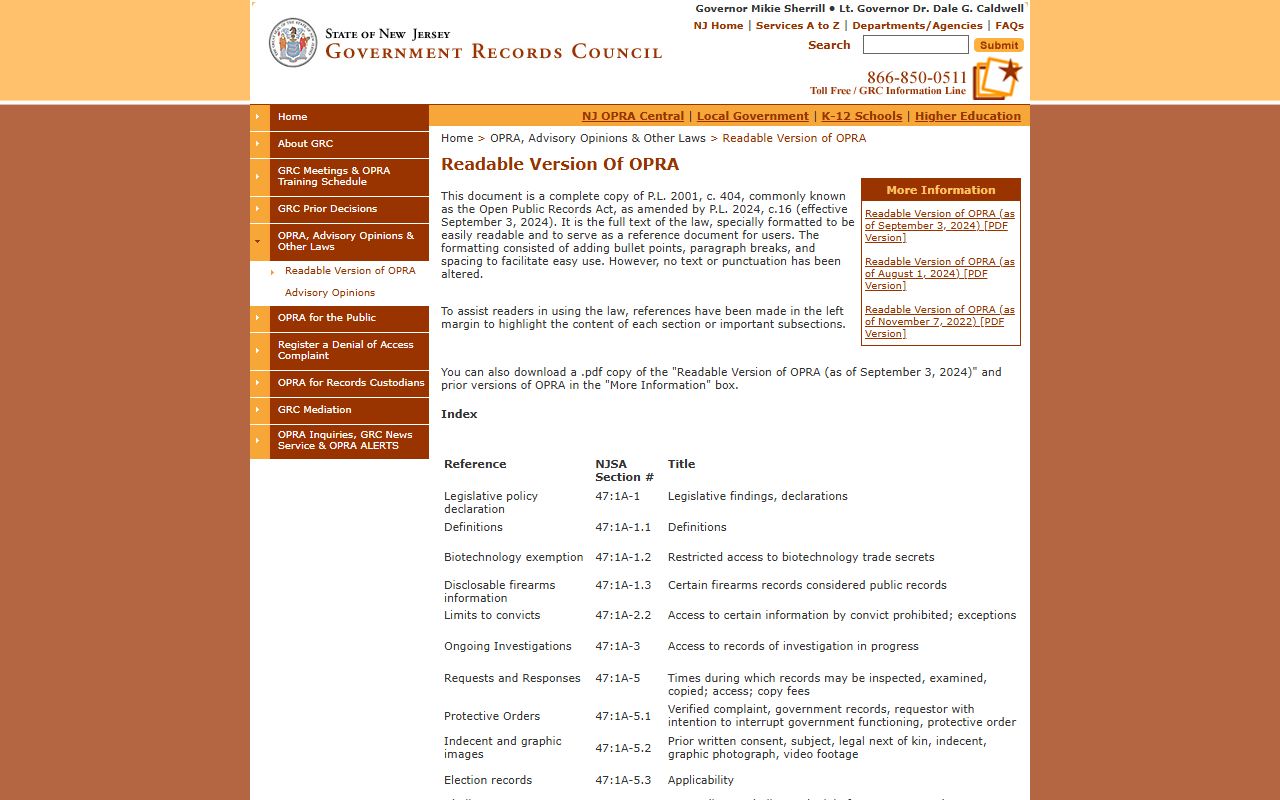
That version reflects changes from P.L. 2024, c.16. Those amendments are covered in more detail in the section on the 2024 OPRA update below.
How to File a Somerset County OPRA Request
Somerset County uses two submission paths for public records requests: the JustFOIA online portal and a downloadable PDF form. The portal lets you submit, track, and search past requests without mailing anything. The PDF form works when you prefer to send a paper request by mail, fax, or in person. Either way, the request goes to the same custodian.
The GRC Citizen's Guide to OPRA recommends being specific about the records you want. Broad or vague requests can slow the response or produce a clarification reply. OPRA allows the custodian to ask you to clarify before responding if the request is unclear. State the record type, date range, subject, and department when you know them. The custodian uses that detail to locate documents quickly and route the request to the right office.
The screenshot below shows the GRC Citizen's Guide, updated October 2024 to reflect the P.L. 2024, c.16 amendments. Use it as a reference before you file your first request.
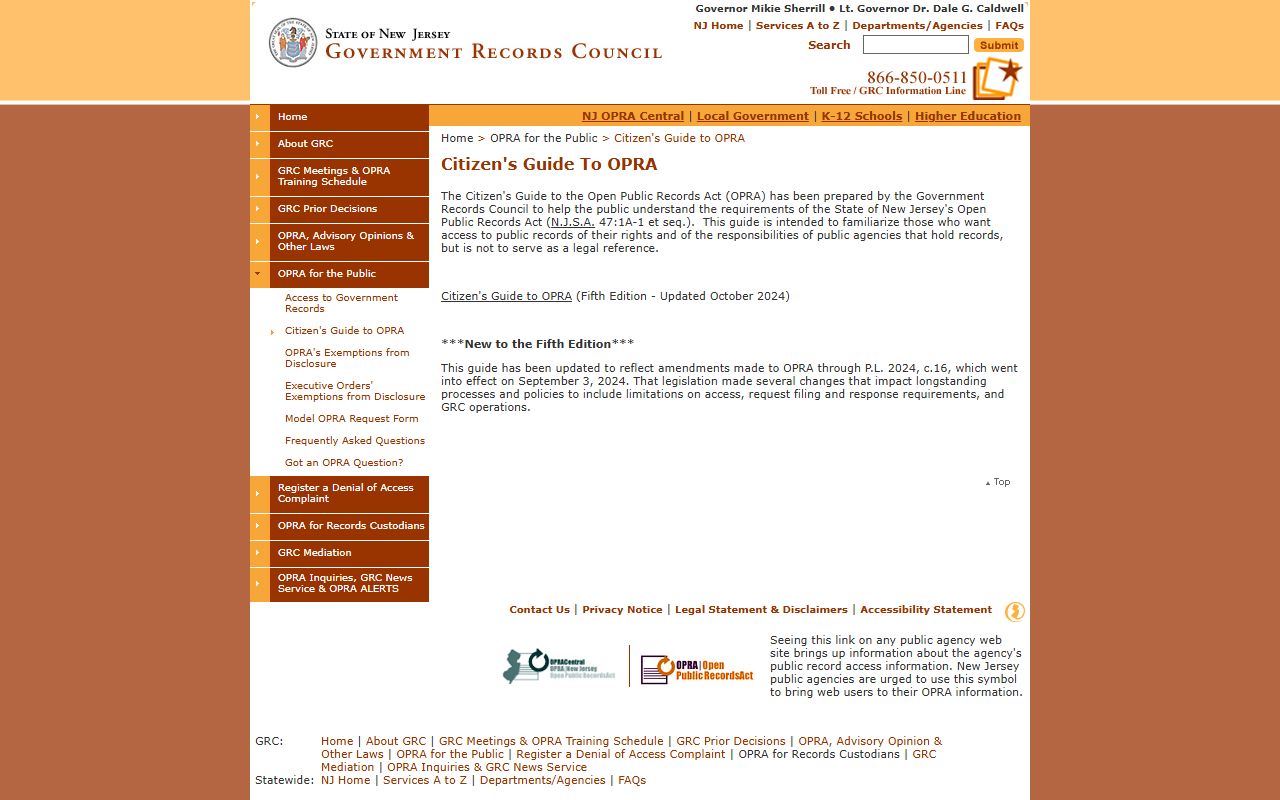
Filing steps for a Somerset County OPRA request:
- Go to the Somerset County OPRA page and choose New Request in the JustFOIA portal, or download the PDF form from the county's OPRA documents page.
- Fill in your name, address, phone, and email or fax. An email address lets the custodian enter your contact information into the portal automatically when using the PDF path.
- Describe the records you want. Be specific: include document type, dates, subject matter, and the county office that likely holds the record.
- Indicate whether the request is for a commercial purpose if that field appears. The 2024 OPRA amendments added requirements around commercial-purpose certification.
- Choose your delivery method: inspection at county offices during business hours (free), mail, or fax.
- Sign and date the form if using the PDF version. OPRA requires a written request.
- Submit: online through JustFOIA, by mail to 20 Grove Street, P.O. Box 3000, Somerville, NJ 08876-1262, or by fax to 908-231-8754.
- Track your request through the JustFOIA portal using the Track Status button, or wait for the county's response within seven business days.
The county custodian is Kelly Mager. Her phone is 908-231-7030 and her email is OPRA@co.somerset.nj.us. She can answer questions about the request process, confirm whether the county holds a particular record, and direct you to the right department if the record sits elsewhere in county government.
Somerset County OPRA Request Form Fields
The Somerset County OPRA PDF form and the JustFOIA portal collect the same information. Completing every field fully is the fastest path to a response. The county recommends completing the PDF in Acrobat Reader rather than a browser, because browser fill tools may not save fields correctly and the form may appear blank when printed or submitted.
The table below maps the main form sections and what each one asks for.
| Field / Section | Type | Required | Notes |
|---|---|---|---|
| Requestor information | Text fields | Yes | Name, address, phone, and email or fax; complete in Acrobat Reader for best results. |
| Records requested | Multiline text | Yes | Describe records specifically; OPRA requests specific records, not isolated facts or general information. |
| Commercial purpose certification | Checkbox or signature | If applicable | 2024 OPRA amendments address commercial-purpose requests; certify if records will be used commercially. |
| Delivery method | Checkbox | Yes | Mail, fax, or in-person inspection; inspection during business hours is free. |
| Signature and date | Signature / date | Yes | OPRA requires a written, signed request for all submissions. |
Note: The JustFOIA portal has three main functions: New Request to start a submission, Track Status to check a pending one, and Search Archive to look through past public requests filed with the county.
What Records the County Holds in Somerset County
The county custodian fields requests for records held by county agencies. Somerset County agencies cover a wide range of documents. Before submitting a request, knowing which office holds the record helps. The custodian routes the request to the right department, and that step takes longer when the record's location is unclear.
Land records are a major category. The Somerset County Clerk, Steve Peter, records deeds, mortgages, tax liens, notices of settlement, federal tax liens, inheritance tax waivers, UCCs, and related real property documents. These are searchable through the Acclaim land records portal using name, book and page, instrument number, document type, or date range. Some categories go back to 1800 in the Alpha Index. The County Clerk's office is at 20 Grove Street, open Monday through Friday, 8:15 a.m. to 4 p.m., with extended hours on Wednesdays until 6 p.m.
Sheriff records are another category handled through OPRA. The Somerset County Sheriff's Office maintains law enforcement records, civil process filings, warrant investigation logs, and administrative records for its divisions. Those records fall under OPRA when held by the Sheriff as a county agency. The jail itself shifted to a shared-services model in 2024. Somerset now processes detainees at its facility and transfers longer-term custody to Morris County. So jail administrative records may split between the two agencies depending on where the record was created.
Other county record types that come through the OPRA custodian include county budget documents, Commissioner minutes and resolutions, county administrative correspondence, the Surrogate's public docket entries, Human Services program records not protected by privacy law, and election-related records held by the Clerk. Records from the Somerset County Prosecutor's Office may be subject to investigatory exemptions even when requested through OPRA. That office prosecutes indictable crimes on behalf of the State, and case investigation files are frequently exempt under N.J.S.A. 47:1A-3.
Note: Surrogate's Court public docket entries for uncontested probate filings are county records. Contested or court-supervised probate matters handled by the Superior Court Chancery Division, Probate Part are Judiciary records and do not go through the OPRA custodian.
Fees and Response Timelines for Somerset County Public Records
OPRA sets a standard response time of seven business days. That count does not include weekends or holidays. Somerset County's OPRA page confirms records are normally available within seven business days. When a request needs additional time because of archive retrieval or records held off-site, the custodian must notify the requester within that seven-day window and give a date when the records will be ready.
On-site inspection of records during normal county business hours is free. You do not pay to come in and view a public record at the county administration building. Duplication fees apply when you want paper or electronic copies. The fee schedule comes directly from N.J.S.A. 47:1A-5.
The screenshot below shows the NJ Department of Community Affairs OPRA overview, which summarizes the statewide law framework that applies to Somerset County and every other public agency in New Jersey.
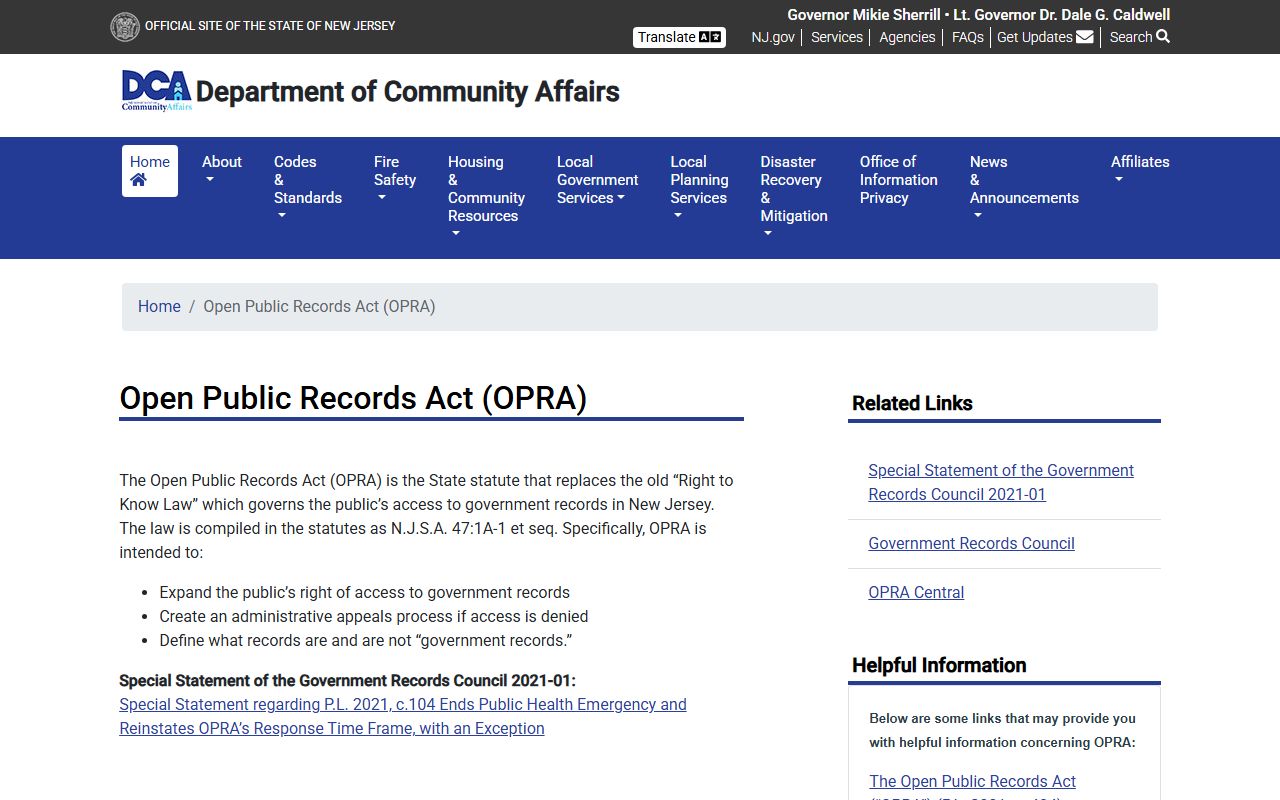
The DCA page provides plain-language context on the framework, and the Government Records Council enforces compliance for county and municipal agencies.
| Copy Type or Service | Fee |
|---|---|
| Letter-size page (8.5 x 11 inches) | $0.05 per page |
| Legal-size page (8.5 x 14 inches) | $0.07 per page |
| Electronic media (CD, DVD, or other) | Actual cost of the medium |
| On-site inspection during business hours | Free |
These rates apply unless another law sets a different fee for a specific record type. County Clerk recording fees and surrogate court filing fees are set by separate statutes and are not subject to OPRA copy rates. Check the specific office's fee schedule when requesting those categories.
OPRA Appeal Rights After a Somerset County Denial
If the county denies your request, you have two paths forward. You can file an action in Somerset County Superior Court, or you can file a complaint with the New Jersey Government Records Council. Both options are available under N.J.S.A. 47:1A-6. You do not have to pick one before the deadline; take time to evaluate which fits your situation before acting.
The GRC is a state administrative body set up to receive complaints from requesters whose records were denied, improperly delayed, or partially withheld. The GRC reviews the custodian's decision and asks both sides to submit information before issuing a decision. If the GRC finds a violation, a prevailing requester may also be awarded attorney fees under the statute. One limit applies: the GRC has no jurisdiction over the Judiciary, so this appeal path only works for Somerset County agency records. Court records access disputes go through the court system directly.
Filing in Superior Court is another option. It can be faster for urgent requests or when the legal question is complex enough that an administrative process would take too long. That action goes to Somerset County Superior Court. An attorney experienced in OPRA can weigh which path is more appropriate given the specific denial reason the county gave.
A county denial must state the legal basis for the claimed exemption. If the denial cites a specific statute or provision, you have a concrete issue to address in your appeal. A vague denial without a stated legal basis is itself a potential OPRA violation and strengthens the case for challenging it.
Records That Are Restricted Under Somerset County OPRA
OPRA does not open every county document. Several categories are exempt from disclosure, and the custodian must deny requests that fall into those categories. The exemptions come from the OPRA statute itself, from other New Jersey laws, and from federal rules. Knowing the main exempt categories helps set realistic expectations before you file.
Personnel and pension records are generally not public under N.J.S.A. 47:1A-10. The statute carves out specified employment facts such as name, title, salary, and date of employment as public, but the rest of an employee's personnel file stays closed. Pension account details are also protected. If you want to know a county official's salary, that is public. If you want a disciplinary investigation file, it generally is not.
Investigatory records present a nuanced exemption. Under N.J.S.A. 47:1A-3, the county can deny investigatory records if release would be inimical to the public interest. However, that same provision requires that certain basic criminal investigation information be made available within 24 hours or as soon as practical even when the full file is exempt. Sheriff's warrant investigation records and Prosecutor's Office case files often fall in this space. You may get some information but not the complete investigatory package.
Personal identifiers must be redacted from any disclosed record. Social Security numbers, driver's license numbers, vehicle plate numbers, insurance policy numbers, active financial account numbers, and active credit card numbers are all protected under Rule 1:38-related guidance and OPRA. If the record you requested contains those fields, you will receive a version with those items blacked out, not an outright denial of the record.
N.J.S.A. 47:1A-2.2 restricts access for people convicted of indictable offenses. A custodian must deny a request by a convicted person seeking personal information about a victim or the victim's family. That denial applies even if the underlying document would otherwise be public.
Other exempt categories include records sealed by court order, attorney-client communications, active-litigation files in certain circumstances, graphic or indecent images without consent under N.J.S.A. 47:1A-5.2, and records protected by specific statutes covering juvenile, adoption, mental health, and domestic violence matters.
Key OPRA Statutes for Somerset County Requesters
The Open Public Records Act is codified at N.J.S.A. 47:1A-1 et seq. The policy declaration at 47:1A-1 states that government records shall be readily accessible to citizens unless exempt, and that the law shall be construed in favor of disclosure when an exemption claim is close. Somerset County must apply that principle when reviewing any request. The following callout covers the three provisions most relevant to a standard county public records request.
N.J.S.A. 47:1A-1 (Policy): Declares that all government records shall be subject to public access unless exempt. Access is construed broadly in favor of the public, and exemptions are to be applied narrowly.
N.J.S.A. 47:1A-5 (Requests, Responses, and Fees): Sets the seven-business-day response window, the $0.05 per letter-size and $0.07 per legal-size copy-fee structure, and the free inspection right. Full text at the GRC statute page.
N.J.S.A. 47:1A-6 (Challenge to Denial): Gives a denied requester the right to file in Superior Court or complain to the GRC. A prevailing requester may be awarded reasonable attorney fees.
Common law access is preserved by N.J.S.A. 47:1A-8. OPRA does not reduce whatever common law access rights existed before the statute was enacted. That matters for certain investigatory records or older documents where courts have found a right of access even when OPRA's own framework would not require disclosure. It is a backstop, not a replacement for OPRA, but it has been used successfully in some New Jersey cases to reach records that OPRA alone would not open.
The 2024 OPRA Update and What It Means in Somerset County
New Jersey amended OPRA through P.L. 2024, c.16, which became effective September 3, 2024. The GRC updated its Citizen's Guide in October 2024 to reflect these changes. Any Somerset County OPRA request filed on or after September 3, 2024 operates under the amended law, not the prior version.
Commercial-purpose certification is more prominent under the 2024 amendments. Requesters who plan to use records for a commercial purpose must certify that fact. The county may assess fees that differ from the standard copy rates for commercially motivated requests. If you mark yes on the commercial purpose question in JustFOIA or on the PDF form, the county's response will address that certification and may note different fee rules.
The amendments also adjusted response requirements and GRC operating procedures. The GRC updated its complaint forms and internal review timelines to match the new law. If you are filing an appeal to the GRC after a denial that occurred on or after September 2024, use the current GRC forms. Older forms may not reflect the process as it now works.
County public notices are also changing under related legislation. Under P.L. 2025, c.72, Somerset County states that the complete text of county legal notices may be viewed and printed on the county website, and beginning March 1, 2026, those notices will also appear on the official Secretary of State legal-notice website when that site is established. That affects where you look for public notice documents in the Somerset County record.
Note: The GRC Citizen's Guide is the clearest plain-language summary of what the 2024 amendments changed. It covers timing rules, the commercial-purpose framework, GRC complaint procedures, and fee provisions as they now stand.